Preprint · 2026

KeyDeck: Multi-Paper-to-Slide Generation via Cross-Paper Synthesis and Reference-Guided Personalization

Tarik Can Ozden Sachidanand VS Ram Prakash Reddy Motati Ozgur Kara Dilek Hakkani-Tür Junho Kim James M. Rehg
University of Illinois Urbana-Champaign

KeyDeck turns a collection of research papers into one coherent, editable presentation. A per-paper analysis first characterizes each paper on its own, and a cross-paper (contextual) analysis then relates the papers to each other and builds a single narrative across them. The deck is personalized from reference presentations: one for how the story is told, another for how the slides look and read.
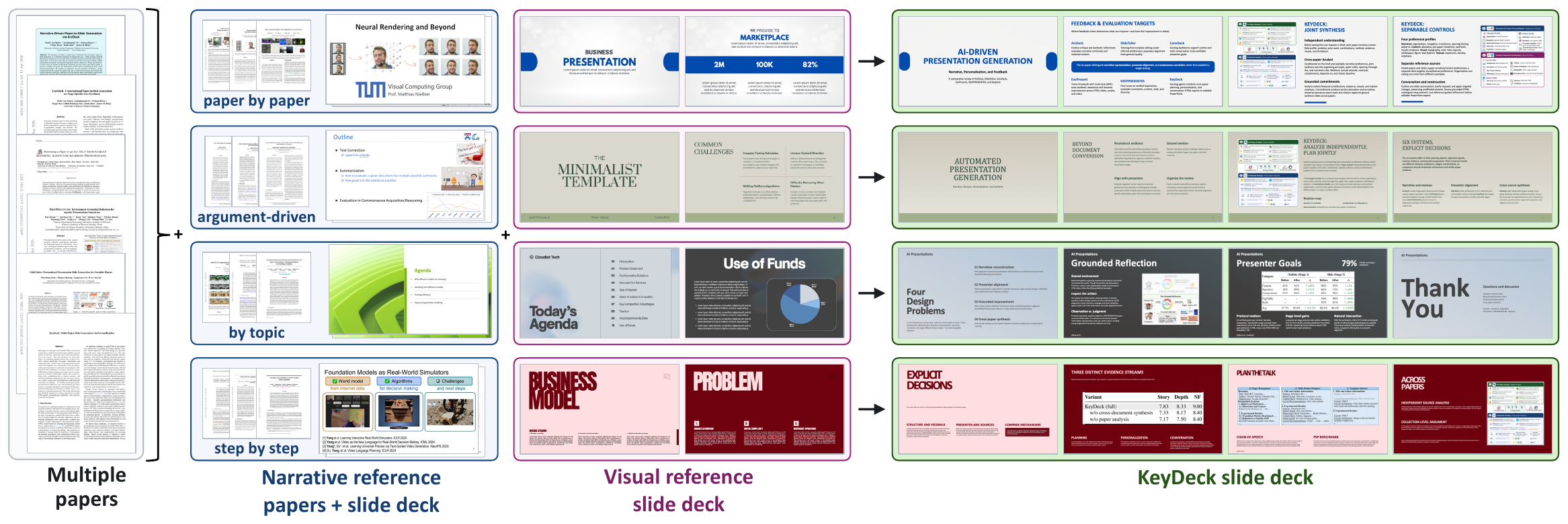
Overview of KeyDeck: multiple papers, a narrative reference (papers plus slide deck), and a visual reference slide deck are combined into a personalized KeyDeck slide deck.
Overview of KeyDeck. Given multiple source papers, KeyDeck generates a coherent slide deck personalized by narrative references (papers and their corresponding slide decks) and a separate visual reference slide deck. The narrative references guide content organization and presentation structure, while the visual reference guides the generated deck's visual and textual style.
The idea

From one paper to many, from instructions to references

Tutorials, keynotes, and survey talks draw on many papers at once, and the same papers can support very different talks depending on who presents them. Prior systems plan around a single source paper, treat extra papers as supplementary material, and personalize mostly from explicit instructions. KeyDeck plans jointly across all papers from the outset and infers the presenter's preferences from presentations they already have.

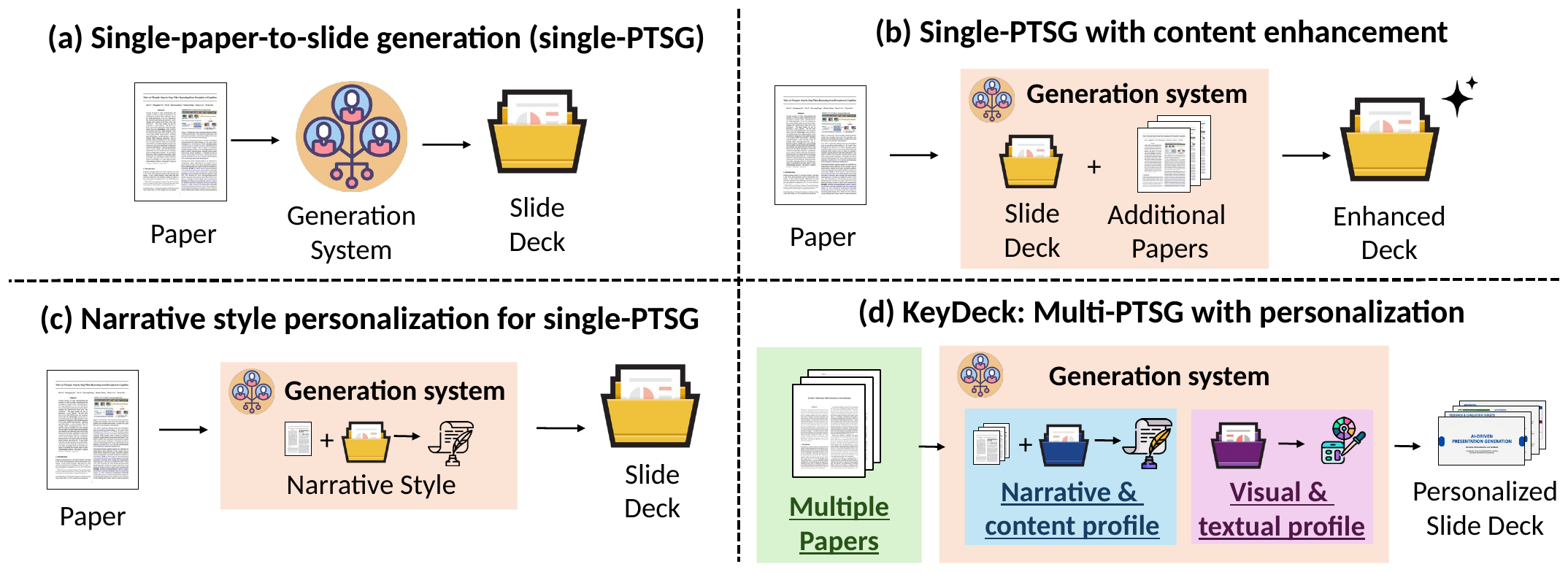
Comparison of paper-to-slide generation paradigms: (a) single-paper, (b) single-paper with supplementary content, (c) single-paper with narrative-style personalization, (d) KeyDeck.
Comparison of paper-to-slide generation paradigms. Previous work focuses on (a) single-paper-to-slide generation (single-PTSG), (b) single-PTSG with supplementary content from additional papers, and (c) single-PTSG with narrative-style personalization, while (d) KeyDeck jointly synthesizes multiple papers with narrative, content, visual, and textual personalization.
Multi-PTSG

Cross-paper synthesis

Per-paper analysis followed by joint cross-paper analysis finds a through-line, a presentation order, and a relation map, so the deck tells one story instead of concatenating summaries.

Personalization

Reference-guided, four dimensions

Narrative and content preferences come from a reference paper(s)–deck pair; visual and textual preferences come from a separate reference deck. The two can be mixed freely.

Benchmark

KeyBench

100 expert-authored multi-paper presentations paired with their source papers, with protocols for generation quality, personalization adherence, and conversational goal satisfaction.

How it works

Three stages, from PDFs to an editable deck

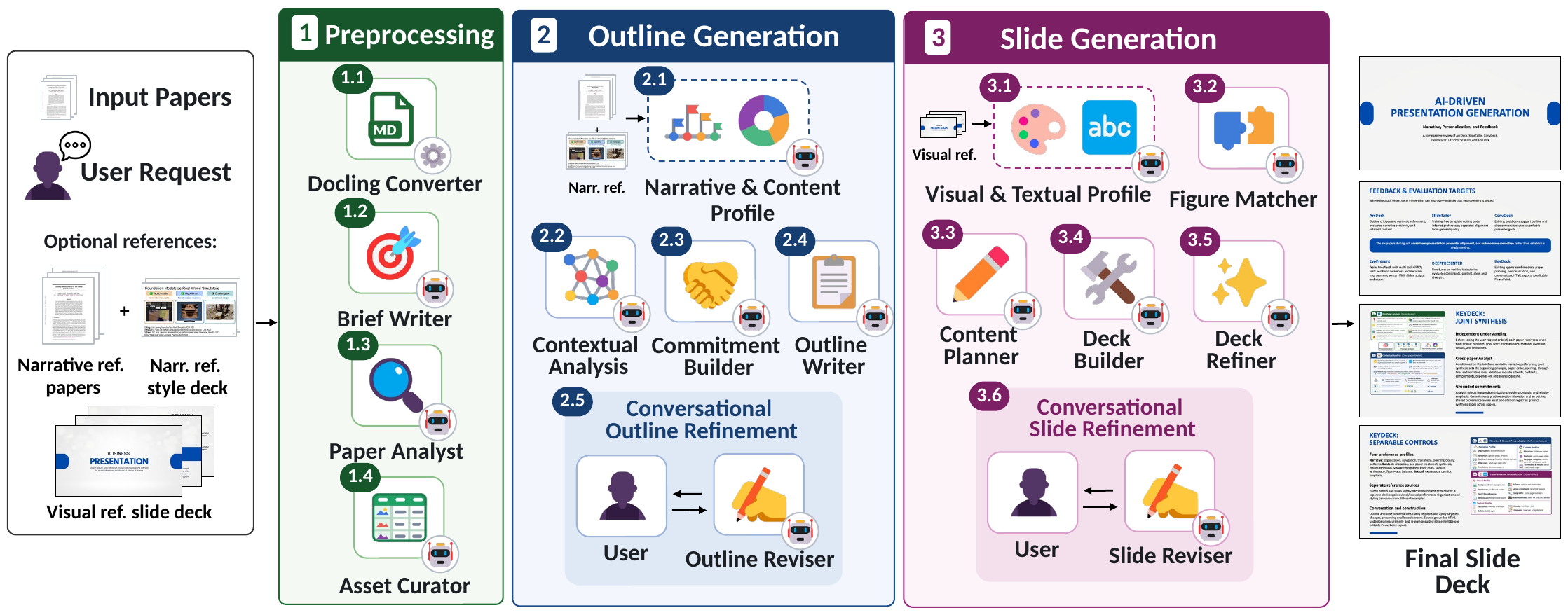
KeyDeck takes one or more source PDFs, an optional natural-language request, and optional personalization references. Users can give free-text feedback on both the outline and the rendered slides; the final output is an editable PowerPoint presentation.

The KeyDeck pipeline: preprocessing, outline generation, and slide generation.
The KeyDeck framework. (1) Preprocessing converts papers to Markdown, derives a presentation brief, and extracts per-paper analyses, metadata, and visual assets. (2) Outline generation integrates the per-paper analyses through cross-paper contextual analysis, guided by narrative and content personalization. (3) Slide generation matches figures and tables to slides and builds the deck with visual and textual personalization, followed by aesthetic refinement.
1

Preprocessing

A Docling Converter turns each PDF into structured Markdown. A Brief Writer derives a presentation brief (purpose, audience, goal, tone, technical depth) from the request. A Paper Analyst independently profiles each paper in eight fields: problem, prior work, contributions, method, evidence, visuals, limitations, and summary. An Asset Curator builds a shared registry of figures and tables that later agents can draw from any paper.

2

Outline Generation Cross-paper synthesis

A Cross-paper Analyst reads all per-paper analyses together and decides the organizing principle, presentation order, a central through-line, and a relation map over the papers (extends, contrasts, complements, depends-on, shares-baseline), then assigns each paper a role and emphasis. A Commitment Builder and an Outline Writer turn this into a slide-by-slide outline, which an Outline Reviser can edit from user feedback.

3

Slide Generation Style personalization

A Figure Matcher assigns figures and tables across the deck, letting synthesis slides draw evidence from several papers. A Content Planner writes source-grounded slide text with citations, a Deck Builder renders an HTML deck, and a Deck Refiner fixes overflow, contrast, whitespace, and figure sizing from rendered-slide measurements. A Slide Reviser applies user feedback, and the deck is exported to editable PPTX.

Conversational

Feedback on outline and slides

Both revisers follow the ReSpAct mechanism: they reason about a request, ask a clarifying question when it is ambiguous, and act through targeted editing tools, without regenerating unaffected slides. On request they can also retrieve background from the web or arXiv.

Output

Editable PowerPoint

Decks are built in HTML for layout flexibility and exported with dom-to-pptx, so the result stays fully editable.

Cross-paper synthesis

Per-paper and contextual analysis

A multi-paper talk has to communicate how its sources connect, not summarize them one after another. KeyDeck gets there in two levels: it first understands each paper independently, then reasons over all of them jointly to decide what story the collection tells and what part each paper plays in it.

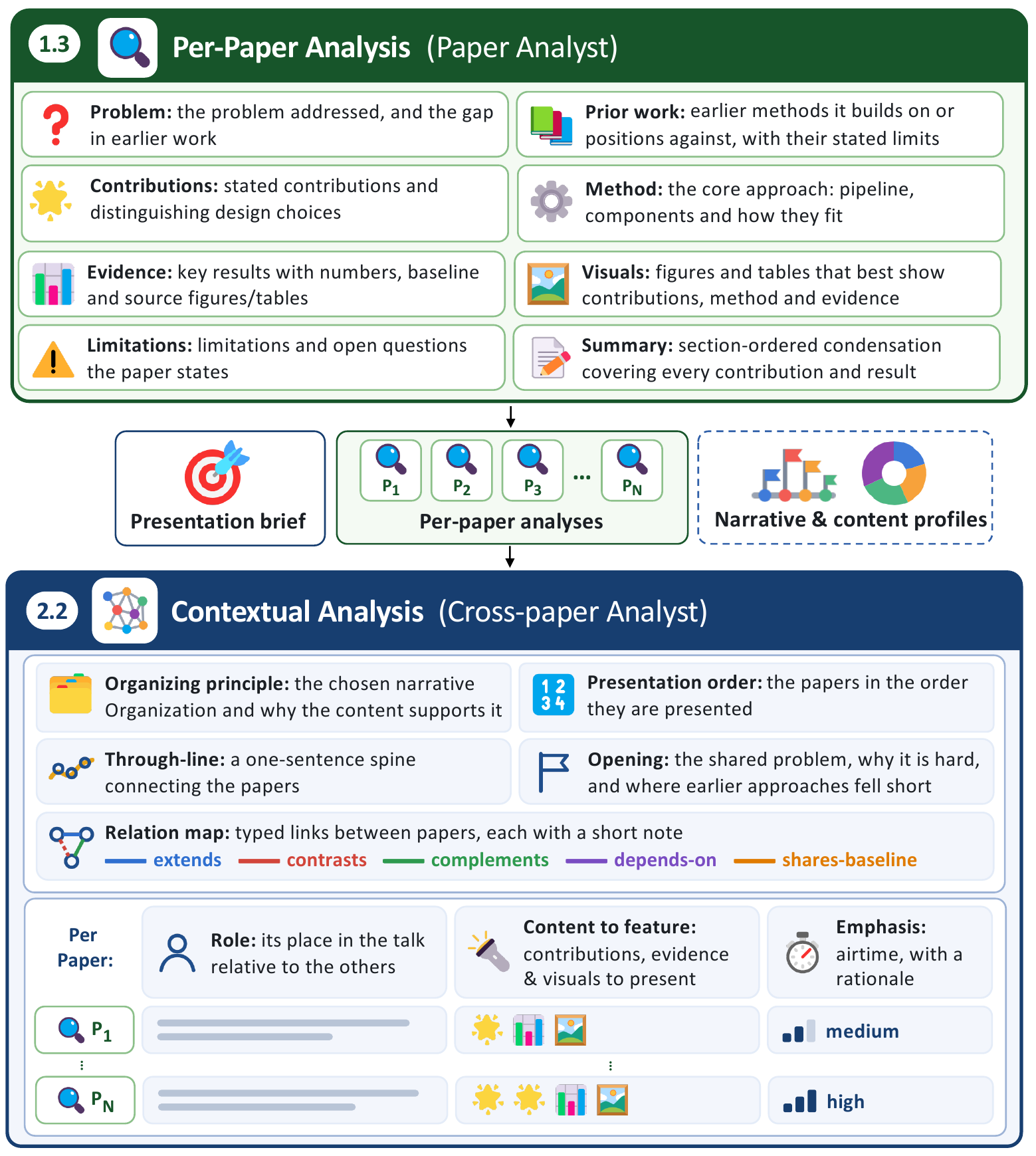
Two-level contextual analysis: per-paper analysis followed by cross-paper analysis.
Two-level contextual analysis. (1) The Paper Analyst independently analyzes each source paper into eight fields. (2) The Cross-paper Analyst integrates these analyses with the presentation brief and optional narrative and content profiles to determine the narrative structure, cross-paper relationships, paper roles, content selection, and relative emphasis.
Level 1 · Per-paper analysis

Each paper on its own terms

A Paper Analyst profiles every paper in eight fields: problem, prior work, contributions, method, evidence, visuals, limitations, and a summary of its principal contributions and supporting results. It runs without the user request or the presentation brief, so each paper is characterized before its relevance to the talk is decided.

Level 2 · Contextual analysis

The collection as one story

A Cross-paper Analyst reads the brief and all per-paper analyses together. For the collection it sets an organizing principle and presentation order, a central through-line, an opening that establishes the shared problem, and a relation map with typed links: extends, contrasts, complements, depends-on, and shares-baseline.

Per paper

Role, content, emphasis

Each paper is assigned a role in the narrative, the contributions, evidence, and visuals to feature, and a relative emphasis. When a content profile is available, its allocation preferences guide these decisions. The result is a structured JSON analysis that drives outline planning.

VariantStory Q/ADepth Q/ANarrative flow
w/o contextual analysis73.381.78.40
w/o per-paper analysis71.775.08.40
KeyDeck78.383.39.00

Ablation on 10 GPT-5-generated samples, evaluated by GLM. Removing either level lowers story- and depth-related question answering and narrative flow.

Personalization

Two references, four profiles

Preferences are rarely written down, but they show in the decks a presenter has already made. KeyDeck reads them from two optional references: a narrative reference (papers plus the deck that presented them) and a visual reference (any slide deck). The organization of one talk can be combined with the look of another.

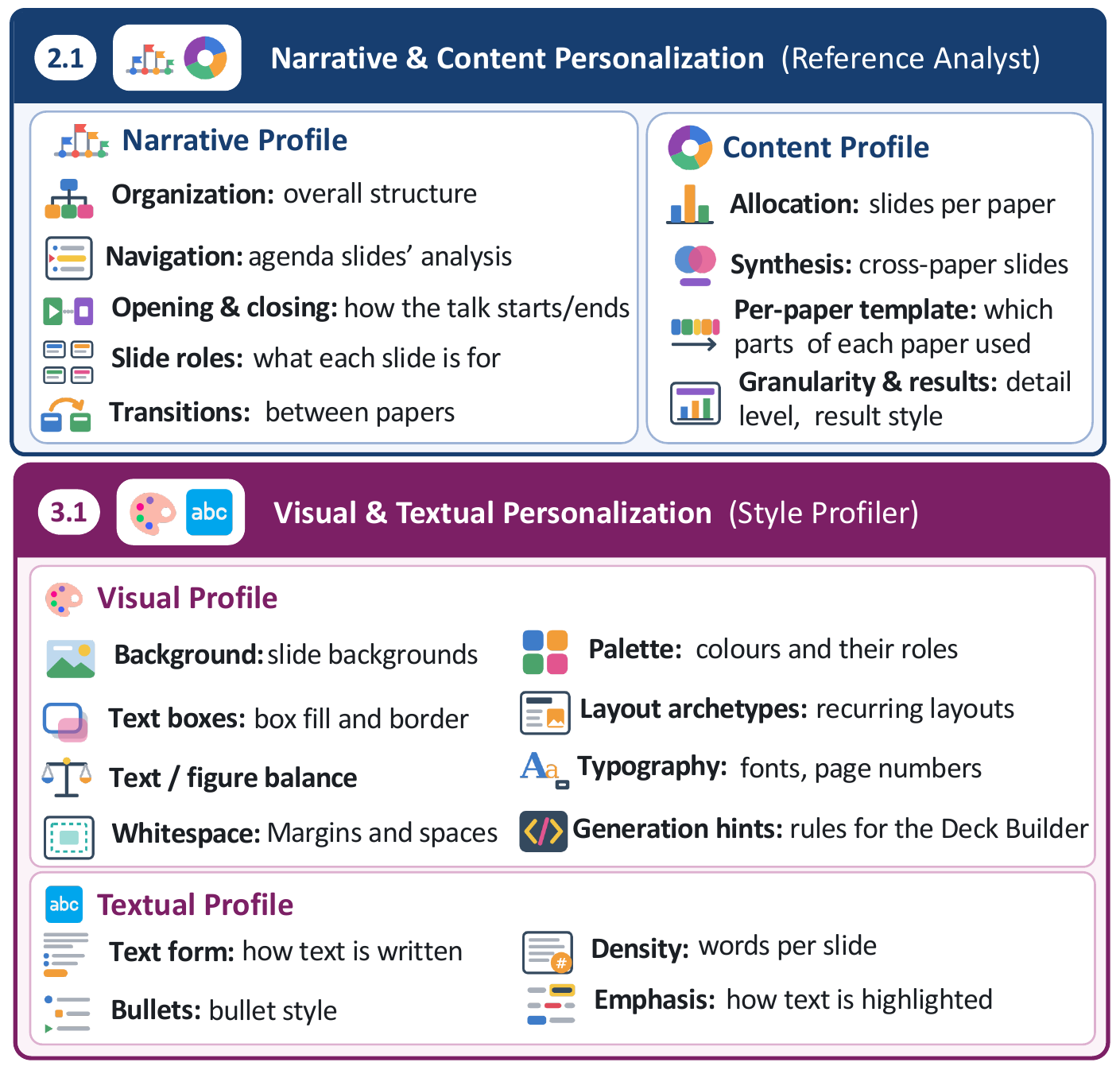
Overview of the narrative, content, visual, and textual personalization profiles.
Overview of the personalization profiles. The profiles capture personalization details across four dimensions: narrative, content, visual, and textual. Profile attributes are represented as categorical choices, quantitative measurements, or natural-language descriptions.
Narrative

How the story is organized

Organization, navigation, transitions, and opening and closing patterns, inferred by a Reference Analyst from the narrative reference.

Content

What gets the slides

Slide allocation, per-paper structure, and how synthesis and results are used across the deck.

Visual

How the slides look

Backgrounds, typography, color roles, recurring layouts, graphical treatments, and the balance between text and figures, extracted by a Style Profiler.

Textual

How the slides read

Preferred forms of expression (paragraphs, bullets, or short phrases), text density, and emphasis conventions.

Benchmark

KeyBench

KeyBench pairs 100 source-paper sets with the expert-authored presentations built from them, collected from tutorials and keynotes at CVPR, ICCV, ECCV, ICLR, NeurIPS, ICML, ACL, and EMNLP and their workshops. We also release the full collection of 397 slide decks gathered from the same venues.

100
Multi-paper presentations with complete source-paper sets
Keynotes and tutorials
8
Major vision, ML, and NLP venues
Plus associated workshops
397
Slide decks in the full released collection
Including 297 without complete source sets
12
Q/A probes per sample
Story, Visuals, Hard, and Depth, three each
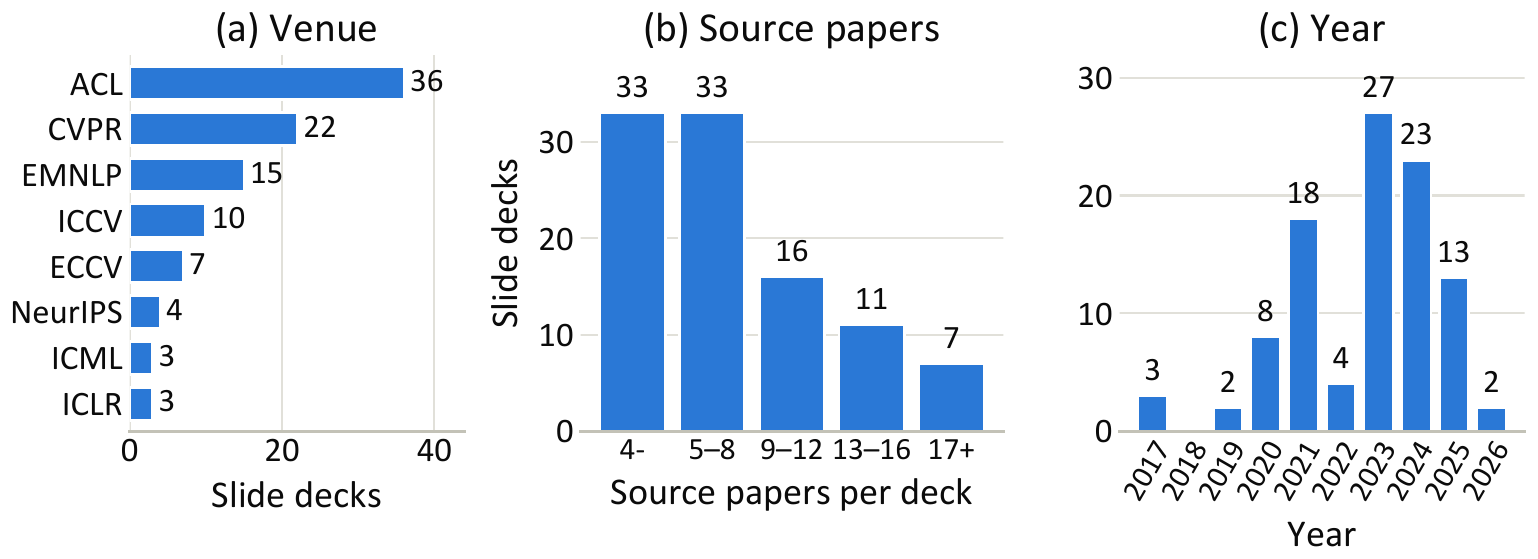
KeyBench distribution across venues, number of source papers per deck, and presentation years.
Overview of KeyBench. Distribution of slide decks across (a) conference venues, (b) number of source papers per deck, and (c) presentation years.
Evaluation

Better decks, closer to the presenter

We evaluate multi-paper generation on KeyBench, single-paper generation on ArcBench, personalization against SlideTailor, and conversational goal satisfaction against ConvDeck and ConvHTML, with GPT-5 and GLM5.3-Flash as both generation backbones and judges.

72.0
Average multi-paper Q/A score on KeyBench
Next best baseline: 45.7 (GPT-5 generation, GPT judge)
≥97%
Pairwise win rate against every baseline
Overall quality, GPT-5 generation
80.7%
Human preference over SlideTailor for personalization
150 pairwise comparisons, 30 participants
84%
User goals satisfied through conversation
ConvHTML 73%, ConvDeck 70%
MethodReference-based Q/A avg. (0–100)Rubric-based quality avg. (0–10)
GPT judgeGLM judgeGPT judgeGLM judge
SlideGen26.9328.206.815.42
ArcDeck44.0547.307.185.25
EvoPresent45.7345.738.034.50
ConvDeck45.0047.107.124.11
DeepPresenter15.6719.655.574.30
KeyDeck71.9573.909.217.89

Multi-paper generation on KeyBench with GPT-5 as the generation model. Averages are over four Q/A categories (Story, Visuals, Hard, Depth) and four rubric dimensions (narrative flow, textual quality, visual thematic consistency, visual layout). KeyDeck also has the highest averages with GLM5.3-Flash generation (Q/A 69.47 / 71.92, rubric 9.34 / 8.84); see the paper for the full tables.

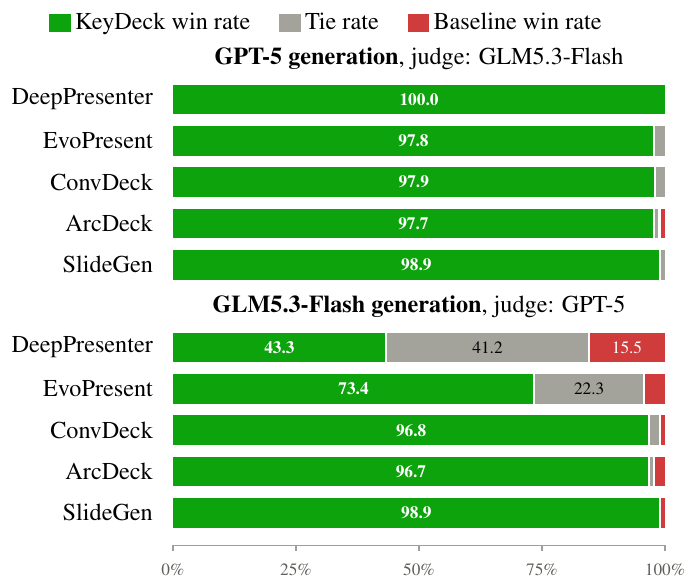
Pairwise overall-quality comparison of KeyDeck against each baseline.
Pairwise quality comparison. Share of decks where KeyDeck wins (green), the two presentation orders disagree (gray), or the baseline wins (red). Each pair is judged twice with the order swapped.
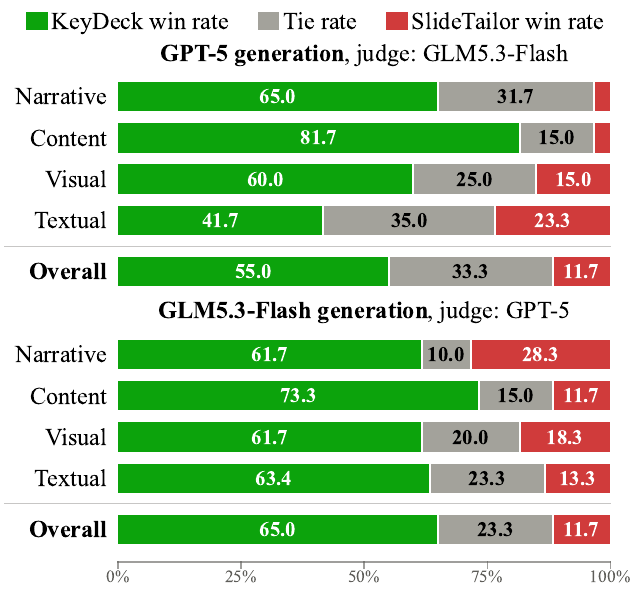
Pairwise personalization judgments of KeyDeck against SlideTailor.
Pairwise personalization judgments. KeyDeck versus SlideTailor on narrative, content, visual, textual, and overall adherence to the references. A win requires agreement across both presentation orders.
Highest average Q/A and rubric scores on KeyBench across both generation backbones and both judges, and the highest average rubric-based quality in the single-paper setting on ArcBench.
In a human ranking study (30 participants, 150 rankings), KeyDeck gets the best average rank of 1.61, ahead of ArcDeck (2.33), EvoPresent (2.77), and DeepPresenter (3.29).
For personalization, KeyDeck wins overall in 55.0% and 65.0% of comparisons with GPT and GLM generation, against 11.7% for SlideTailor in both settings.
Comparable cost: among six methods, KeyDeck ranks third in runtime and fourth in token consumption and inference cost (highest to lowest).
See it in action

Generated decks

Six complete decks generated by KeyDeck, with and without personalization references, every slide in order. Use the arrows (or ← / → keys) to browse, and click a slide to enlarge it.

No personalizationMeasuring Progress in NLPKeynote · 6 source papers · 56 slides · default design style
Visual referenceModel Extraction, Downstream Attacks, and Ownership Verification for NLP APIsTutorial · 6 source papers · 56 slides · styled after a visual reference deck
No personalizationStructured Local Supervision for Transferable Visual RepresentationsKeynote · 5 source papers · 53 slides · default design style
Visual referenceStructured Control and Consistency in Diffusion-Based Visual ComputingKeynote · 6 source papers · 56 slides · styled after a visual reference deck
Narrative + visual referenceCompositional Action Recognition: Interaction Dynamics and Semantic KnowledgeKeynote · 3 source papers · 23 slides · organized after a narrative reference, styled after a visual reference deck
Visual referenceFew-Shot Learning: Learned Comparisons and Rapid AdaptationTutorial · 6 source papers · 56 slides · styled after a visual reference deck
Cite

Citation

If you find KeyDeck or KeyBench useful, please cite our paper.

@article{ozden2026keydeck,
  title     = {KeyDeck: Multi-Paper-to-Slide Generation via Cross-Paper
               Synthesis and Reference-Guided Personalization},
  author    = {Ozden, Tarik Can and VS, Sachidanand and
               Motati, Ram Prakash Reddy and Kara, Ozgur and
               Hakkani-T{\"u}r, Dilek and Kim, Junho and Rehg, James M.},
  journal   = {arXiv preprint arXiv:2611.33715},
  year      = {2026},
  url       = {https://arxiv.org/abs/2611.33715}
}